My first holiday read this summer has been Talking to Strangers (2019) by Malcolm Gladwell.
I have always been drawn to Gladwell. His writing is, to me, thought-provoking and easily digestible.
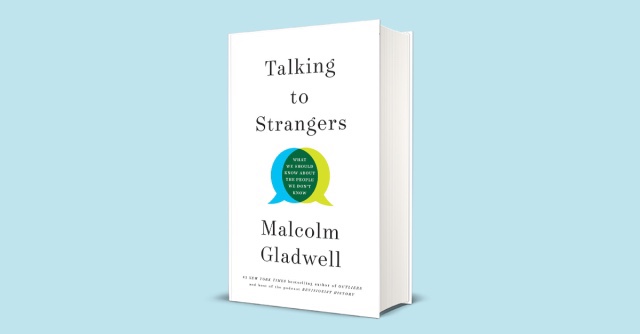
Talking to Strangers takes on the ways we aim to make sense of people we’ve just met – and how, invariably, we get it wrong.
As an educator and community leader, I meet new people every week. New members of my community choir join every Thursday night. Each prospective staff member looking to work at my school sits with me in my office for an interview, after which (or usually during which) I decide whether or not they would be a good fit for the organisation. Each semester, a new group of students enters my classroom for the first time, many of whom I’ve not taught before. With each of these hundred or so ‘strangers’ each year, there are so many immediate – and gradual – assessments that are made as we make sense of each other.
I have always considered myself a good judge of character.
I have always said that I can read people well.
Gladwell’s book aims to cover ‘what we should know about the people we don’t know’. Much of the text takes examples from crime. Gladwell highlights how often we misread others because of our predisposition to default to truth (that people are genuine and honest) or our assumption that human communication and expression is transparent (that WYSIWYG).
I found the notion of transparency the most intriguing and the most able to relate to the experience of my world as teacher and music director. It’s easy to assume that someone’s facial expression is an indicator of their internal disposition. I do it often. I think we all do. Gladwell argues that it’s a simple – and incorrect – assumption to make.
Gladwell is, as always, well-researched. He uses the decade-old criminal case of Amanda Knox as his exemplar of this mistake. If Gladwell were Australian, perhaps the chapter would have centred on Lindy Chamberlain and the disappearance of her daughter, Azaria, at Uluru forty years ago. In both cases, presumptions of guilt were made (at least in part) because Knox and Chamberlain’s behaviour and expression didn’t match what we believe people experiencing distress or grief should display on their face and show in their behaviour.
However, sometimes, people are mismatched. Their expression or their behaviour doesn’t provide a reliable insight into how they feel. They don’t show emotion through the anticipated facial expression. I can think of a number of people in my life for whom, after reading Talking with Strangers, I’m left to wonder if such a mismatch explains what I’ve always found to be confusing – yet such intriguing – behaviour.
If he’s enjoying himself so much, perhaps he should tell his face.
Probably said by me (2019)
It’s tongue-in-cheek, but it’s the sort of thing that gets bandied about in casual conversation. At least, it does in my social circles.
Gladwell has left me thoughtful about the ways in which we claim to know and understand those around us, particularly those we’ve just met or those who are in our lives peripherally or as acquaintances.
He doesn’t propose strategies to understand others better, but rather warns against assuming we know how to make sense of others:
Because we do not know how to talk to strangers, what do we do when things go awry with strangers?
We blame the stranger.
Gladwell (2019), p. 346
Perhaps we need to look at ourselves first.

 Adam Majsay